Late payment statistics for UK sole traders
Late payment statistics for UK sole traders: how often you're paid late, how long you wait, how much is owed and what chasing methods people actually use.

Hiscox asked 1,000 sole traders, small business owners and directors about late payments. The survey ran in May 2025 and Hiscox published the results in February 2026. Some of the answers are what you'd expect. Some aren't.
Here are the late payment statistics for UK sole traders, and what I think they say.
How often are sole traders paid late?
Hiscox says other sectors reported up to one in five payments arriving late. Among all the businesses it asked:
- 36% said up to 20% of their invoices are not paid on time.
- 24% said up to 30% of their invoices need chasing.
So if you're paid late on a fifth of your jobs, you're normal. That's not a comfort when it's your rent week.
How long do you wait?
Hiscox found that 30% of small businesses typically get a late payment two weeks after the due date. Businesses with up to 49 employees reported delays of up to three weeks. Sole traders reported delays of up to two weeks.
Glasgow and Newcastle reported average waits of up to one month, according to the same report.
Two weeks sounds short. Say you're a cleaner who invoices £400 on the 1st with 7 day terms. Payment is due on the 8th. A two week delay means the money lands around the 22nd. That's an example, not a Hiscox case. But for someone paying bills monthly, it moves the cash into the next month.
How much is owed?
Here Hiscox gives a mixed picture for sole traders:
- 23% of sole traders were owed nothing by the end of the year.
- 36% of sole traders were out of pocket by up to £1,000.
- Most businesses are chasing around £400 per late payment, Hiscox says.
The report also estimates that between £27.3 billion and £54.5 billion is owed across the UK each year. It's an estimate, built by scaling survey answers up to the whole small business population. Treat the exact range with care. The point is that it's a huge number.
How much time does chasing take?
Most people estimated up to two hours a month. And 37% are chasing 10 to 20 late payments.
Two hours doesn't sound like much. But it's two hours of unpaid, uncomfortable admin, every month, on top of the work. I wrote about the personal side in the real cost of chasing.
How do small businesses chase?
This is the part I find most interesting. Hiscox asked what people do about it.
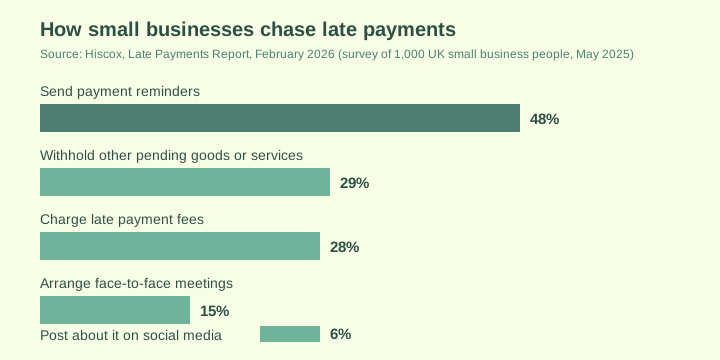
Almost half send a reminder. That's the right first move. Less than a third charge late payment fees. I explain what interest you can charge in late payment interest in the UK.
Note that this chart covers all the businesses Hiscox asked, not only sole traders.
Are sole traders worse off than bigger firms?
Not on every measure. Hiscox found that 58% of all respondents named late payments as their most problematic cash flow issue. That rose to 63% among businesses with 10 to 49 employees, and fell to 46% of sole traders.
I'd read that carefully. It doesn't mean sole traders are safe. A bigger business can absorb one late invoice. If you have two main clients and one pays six weeks late, it's your whole month. Hiscox's own survey is a snapshot, and the answers come from people who chose to take part.
It also varies by trade. In architecture, engineering and building, 68% named late payments as the most problematic issue. For HR firms it was 31%.
What should you do with these numbers?
Three things, I think.
- Plan for a two week delay. If you set a 7 day deadline and expect to be paid on day 21, your cash flow plan matches reality.
- Send the reminder the day payment is due. Almost half of the people Hiscox asked send reminders, and it's the cheapest tool you have. My post on how to chase an unpaid invoice has the wording.
- Make paying easy. A late payment is often an invoice sitting in an inbox while someone looks for your bank details. A payment link in the message removes that step.
My take
The numbers say late payment is common and mostly mild. A typical sole trader waits up to two weeks and is owed a few hundred pounds. That's the reason it gets ignored. It never feels big enough to act on.
But it adds up to a few hours a month, a lot of awkward messages, and a cash flow plan that never quite works. The fix is rarely a tougher tone. It's making the first message fast and the payment step easy.
That's what I'm building Vcents for. You ask for the money in WhatsApp, your customer pays from their banking app, and the money goes straight into your account.
Sources
- Hiscox, Late Payments Report: The impact on sole traders and small businesses, February 2026. Survey of 1,000 UK sole traders, small business owners and directors by Censuswide, May 2025.
About the author · Drafted with AI help, then published by Vince, who answers for every piece. Figures come from the primary sources linked in each article. Spot a mistake? Tell us on WhatsApp and we fix it.
Read next
- National insurance for the self-employed: Class 2 and 4 · Tax and admin
- Should I drop a late-paying client? My honest answer · Late payment
- The real cost of chasing · Late payment
- Should I offer a discount for early payment? · Late payment
Stop chasing the same clients by hand.
Vcents sends the reminder on WhatsApp for you, and tells you the moment the money lands in your bank.
How receiving payments works