Late payment interest UK: what you can charge
Late payment interest UK rules in plain numbers: 8% above Bank Rate plus a fixed £40, £70 or £100. See what a late £1,000 invoice really adds up to.
A business customer pays you 30 days late on a £1,000 invoice. The rules let you add £79.66 to the bill, at today's Bank Rate. Plenty of us add nothing and just wait for the money to turn up.
You can charge late payment interest in the UK, and the rules are simple. This post puts real numbers on them so you can see what you're giving up.
What is the late payment interest rate in the UK?
GOV.UK says statutory interest on a late payment between businesses is "8% plus the Bank of England base rate". That's 8 percentage points on top of Bank Rate.
The Bank of England's page, published on 17 September 2026, shows Bank Rate at 3.75%. So at today's rate, the statutory rate is 11.75% a year. Bank Rate can change, so check the Bank of England's rate tables for the figure that applies to your invoice. GOV.UK points you there.
Two limits matter:
- It only covers business to business work. GOV.UK says it doesn't cover consumers. If you're a tutor or a hairdresser whose clients are private people, this law isn't for you.
- A contract can set a different rate. If your terms say something else, the contract wins.
When does an invoice count as late?
GOV.UK says that if you agreed a payment date, it should usually be within 60 days for business transactions. Businesses can agree longer, but it has to be fair to both sides.
If you agreed no date, the payment is late 30 days after your customer gets the invoice, or 30 days after you deliver the goods or finish the service, whichever is later.
That's why a payment term on every invoice helps. It removes the argument. Our guide to writing an invoice covers where to put it.
The fixed fee is bigger than the interest
This is the part I didn't expect. On small invoices, the interest is tiny. The fixed fee is what counts.
GOV.UK lists fixed debt recovery costs you can charge a business that pays late:
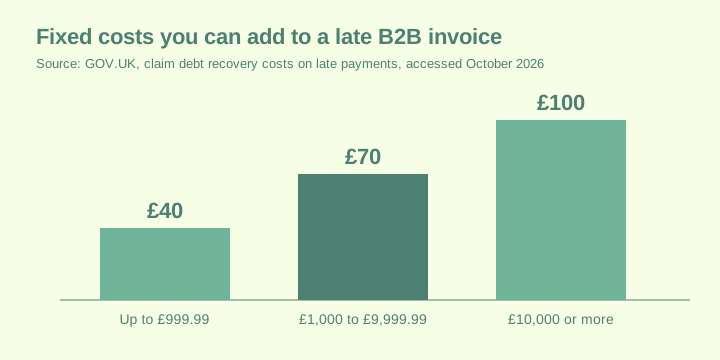
GOV.UK also says you can only charge this once for each payment. And you can claim it on top of the interest.
Now the example. Say you're a freelance designer and you invoice a business £1,000. It pays 30 days late. At 11.75% a year:
- Interest for a year on £1,000 would be £117.50. That's about 32p a day.
- 30 days of that is £9.66.
- The fixed cost for a £1,000 debt is £70.
- Total you can add: £79.66.
The interest sums are my own working, not a figure from GOV.UK. GOV.UK gives a similar example at a different base rate, where interest on £1,000 is £85 a year, about 23p a day.
Now a smaller job. Say you're a cleaner invoicing a letting agency £500. Thirty days late, the interest is £4.83 and the fixed cost is £40. That's £44.83, and 89% of it is the fixed fee. Without the fixed fee, the claim would hardly be worth sending.
How to actually charge it
GOV.UK says to send a new invoice to add interest to the amount owed. Don't just edit the old one.
A simple routine:
- Wait until the payment is properly late, using the dates above.
- Work out the interest: amount, times the annual rate, times days late, divided by 365.
- Add the fixed cost for the size of the debt.
- Send a new invoice, with the working shown, and a new short deadline.
- Keep it polite. You're following the rules, not picking a fight.
GOV.UK also says a supplier can claim reasonable extra costs each time it tries to recover the debt, on top of the fixed sum. I'd keep receipts if it gets that far.
Should you charge it?
This is where I land. Charging for lateness is fair. The law gives you the right, and your customer chose to keep your money longer than agreed.
But there's a business reason too. If you never mention interest, there's no cost to paying you last. Put a line on every invoice saying you charge statutory interest on late payments. It gives customers a reason to pay you sooner, and it may mean you never send the second invoice.
If a long-standing customer is late once, I'd probably send a friendly reminder first. If it's a habit, send the new invoice. Our post on how to chase an unpaid invoice has the wording.
At Vcents, we're building payment requests that go through WhatsApp and settle straight into your bank account. Fast payment means you chase less, and charge for lateness less often.
Sources
- GOV.UK: Charging interest on late commercial payments, accessed 16 October 2026
- GOV.UK: When a payment becomes late, accessed 16 October 2026
- GOV.UK: Claim debt recovery costs on late payments, accessed 16 October 2026
- GOV.UK: Late commercial payments overview, accessed 16 October 2026
- Bank of England: Bank Rate, page published 17 September 2026
Vcents turns the thread into a payment.
Ask for money in plain English. Your customer taps once, authorises in their own bank, and the receipt lands back in the chat.
How receiving payments works