How many self-employed women are there in the UK?
How many self-employed women are there in the UK? ONS counts about 1.73 million in 2026, 38% of the total. See how it grew and which trades they work in.
About 1.73 million women in the UK were self-employed between April and June 2026. That's 38.3% of everyone who works for themselves.
The number comes from the Office for National Statistics (ONS). Its EMP14 table, published on 18 August 2026, counts 4,520,245 self-employed people in the UK for April to June 2026. Of those, 1,733,232 were women and 2,787,013 were men.
I wanted to see how that has changed, and where these women actually work. The answer is more interesting than the headline.
How many self-employed women are there in the UK?
For April to June 2026, the ONS estimate is about 1.73 million. It's a survey estimate, so treat it as a close guide and not an exact head count.
For comparison, the same table shows 1,047,539 self-employed women in April to June 2008. That's roughly 686,000 more women now than 18 years ago, an increase of about 65%.
Men went the other way. There were 2,783,697 self-employed men in April to June 2008 and 2,787,013 in April to June 2026. That's almost no change.
So the whole rise in self-employment since 2008 is mostly women. The total went from 3,831,236 to 4,520,245. Women make up around 686,000 of that 689,000 rise.
Women's share of self-employment, 2008 to 2026
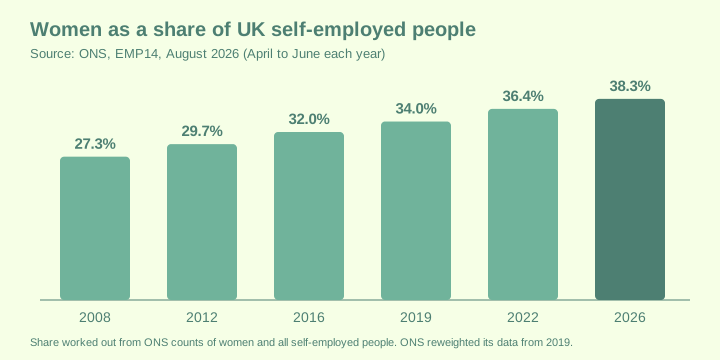
I worked out each share from the ONS counts of women and of all self-employed people. The share rose at every point shown. It was 27.3% in 2008 and 38.3% in 2026.
Two caveats. ONS reweighted its data from January to March 2019, which causes a step change in the series. And it says that because the figures aren't seasonally adjusted, you should only compare the same quarter in different years. That's why every number here is April to June.
The share has also moved a lot in the last year. In April to June 2025 it was 35.9%, and by January to March 2026 it was 38.5%. A jump like that can be partly survey noise, so I wouldn't read too much into one quarter. The longer climb is the safer story.
The ONS October 2026 labour market bulletin also says part-time work rose over the year to June to August 2026 because more people were self-employed and working part-time. It gives no number for that, so I'm only passing on the point.
What do self-employed women do?
The ONS table splits self-employed people by industry. Here are the ones that stood out in April to June 2026:
- Human health and social work: 281,402 women out of 358,059 self-employed people. That's about 79%.
- Education: 199,508 women out of 323,720. About 62%.
- Other services: 364,410 women out of 620,645. About 59%.
- Professional, scientific and technical activities: 245,708 women out of 597,253. About 41%.
- Construction: 31,619 women out of 767,969. About 4%.
Say you're a private tutor, a self-employed carer or a one-person bookkeeper. You're in a sector where women are the majority or close to it. Say you're a self-employed electrician. You're in the one big sector where women are still rare.
Construction is the largest self-employed sector, with 767,969 people. So the gap there pulls the overall share down. Women are already more than half of the self-employed in three of the sectors above.
Why it matters if you run a one-person business
You can't see the full picture from a headline number. Here's what I take from the data:
- More of your peers are women than you'd guess. If you're a woman running a business on your own, you're one of about 1.73 million.
- Women are most common in service work. Care, teaching and personal services are paid after the work is done. That means you depend on the customer paying on time.
- Small jobs mean many small payments. Say you're a tutor charging £45 a lesson, with 20 lessons a month. That's 20 payments to keep track of. That's a different problem from a builder with three big invoices. If you want to see how I'd handle that, read how to chase an unpaid invoice.
For a wider look at the whole picture, I wrote about how many self-employed people there are in the UK earlier.
My take
The story of UK self-employment in the last 18 years is mostly a story about women starting their own work. The total is up by around 689,000 and almost all of that is women.
I don't expect this to reverse. A phone is enough to run a small service business. The problem is that the admin hasn't kept up. Most one-person businesses still get paid by sending a bank detail and hoping.
That's why we're building Vcents around WhatsApp. You ask for the money in a chat, your customer gets a link and pays from their bank app. It's the same chat you already use to book the work.
Sources
About the author · Drafted with AI help, then published by Vince, who answers for every piece. Figures come from the primary sources linked in each article. Spot a mistake? Tell us on WhatsApp and we fix it.
Read next
- What is an SA302? A guide for the self-employed · Tax and admin
- Sole trader or limited company? My take for 2026 · Sole traders
- Your customer opened WhatsApp. Your invoice didn’t. · Sole traders
- How to pay yourself as a sole trader in the UK · Sole traders
Know who’s paid without opening a spreadsheet.
Ask Vcents “who still owes me?” on WhatsApp and get the list back in a second.
How receiving payments works