How many self-employed people are there in the UK?
How many self-employed people are there in the UK? ONS and HMRC figures for 2026 show about 4.5 million, still well below the 2019 level.
There were 4.52 million self-employed people in the UK in April to June 2026. That's the latest figure from the Office for National Statistics (ONS), published on 15 September 2026. It's about 444,000 fewer than the 2019 average.
So the answer to "how many self-employed people are there in the UK" is roughly 4.5 million. But HMRC counts a different number, and it's bigger. Here's why, and what the trend means if you work for yourself.
How many self-employed people are there in the UK now?
The ONS counts self-employed people through the Labour Force Survey. Its seasonally adjusted series shows 4,518,000 in April to June 2026. The quarter before, January to March 2026, was 4,568,000.
For comparison, the ONS annual averages in that series are:
- 2019: 4,962,000
- 2021: 4,232,000
- 2025: 4,395,000
The highest quarter in the recent run was October to December 2019, at 5,017,000. Self-employment then fell through 2020 and 2021, hit its low in 2021 and has been creeping back since.
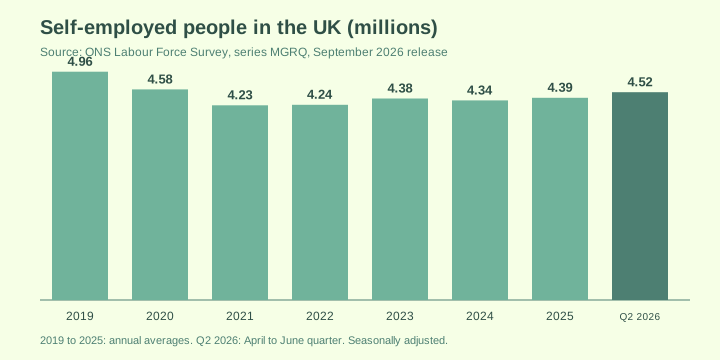
The recovery is slow and uneven. 2024 was lower than 2023. Early 2026 looked strong, then the latest quarter slipped by 50,000.
Is self-employment going up or down?
Both, depending on the measure. The ONS also publishes a count of workforce jobs, which counts jobs rather than people. In its 15 September 2026 bulletin it reported a decrease of 43,000 (1.0%) in the self-employment jobs component over the quarter to June 2026. Over the year, it was down 10,000 (0.2%).
Employees did better. The same bulletin said the number of employees rose by 111,000 on the year to 29.8 million in May to July 2026.
So self-employment is roughly flat over the year, while employee numbers grow. If you feel like fewer people around you work for themselves than in 2019, the data agrees with you.
Why does HMRC show more self-employed people than the ONS?
HMRC's Personal Incomes Statistics for 2023 to 2024, published on 29 April 2026, found 5.34 million individuals with at least one self-employment income source. That was down 0.6% from 5.37 million the year before. Of those, 3.67 million were taxpayers.
That's roughly 800,000 more than the ONS count. The two aren't measuring the same thing. The ONS asks people about their work in a survey. HMRC counts anyone with self-employment income on their tax record, which will include people who do it on the side of a job. The tax years also differ. I haven't seen either body publish a reconciliation, so treat the gap as a likely explanation, not a proven one.
HMRC also reported 5.62 million self-employment sources, with £118 billion in profit. By my own arithmetic that's about £21,000 per source. It's a rough average, and it hides a huge spread between a full-time electrician and someone selling crafts on weekends.
What this means if you work for yourself
Say you're a self-employed tutor with 12 regular students at £40 a lesson. You're one of millions, but you're also a business of one. No finance team, no credit control, no one to chase for you.
That matters because of the size of the group. Millions of people are running their own admin, and a lot of them do it from a phone between jobs. The Late Payments Bill is aimed at exactly this group, and the time cost of chasing is real for all of them.
A few points the numbers support:
- Your income is probably lumpy. The £21,000 average hides a wide spread. Plan for quiet months.
- You're one of millions doing your own admin. Invoicing, chasing and tax all land on one person.
- Getting paid on time is the part you can control. A payment link sent the moment the job is done beats a reminder sent three weeks later.
My take
The headline number hasn't moved much in three years. It's been between 4.3 and 4.5 million people. The 2019 peak looks a long way off. Whatever happens next, those millions of people still run their own admin, and chasing payment is the part most of them dislike.
That's what we're building Vcents for. You request payment in a WhatsApp chat, your customer pays from their bank app, and the money lands in your own account. No new app for them to learn.
Sources
Vcents turns the thread into a payment.
Ask for money in plain English. Your customer taps once, authorises in their own bank, and the receipt lands back in the chat.
How receiving payments works