Most common self-employed jobs in the UK, by the numbers
What are the most common self-employed jobs in the UK? ONS figures for 2026 show construction first at 619,000, then professional services and health.
If you're wondering what the most common self-employed jobs in the UK are, the answer is construction. By a distance. The Office for National Statistics (ONS) counts about 619,000 self-employment jobs in construction for April to June 2026. That's roughly one in every seven self-employed jobs in the country.
I wanted to see the full picture, so I opened the ONS spreadsheet and added up the numbers myself. Here's what's in it.
The most common self-employed jobs, ranked
The ONS publishes self-employment jobs by industry every quarter. The latest edition came out on 15 September 2026. It puts the UK total at about 4.18 million self-employment jobs for April to June 2026. The ONS marks that quarter as provisional, so it may change.
Two quick notes on what the figures are. They count jobs, not people, so someone with two self-employed jobs shows up twice. And they come from a survey, so every number is an estimate, rounded to the nearest thousand.
The ONS sorts jobs into broad industry sections. I added up the divisions inside each section. These are the eight biggest:
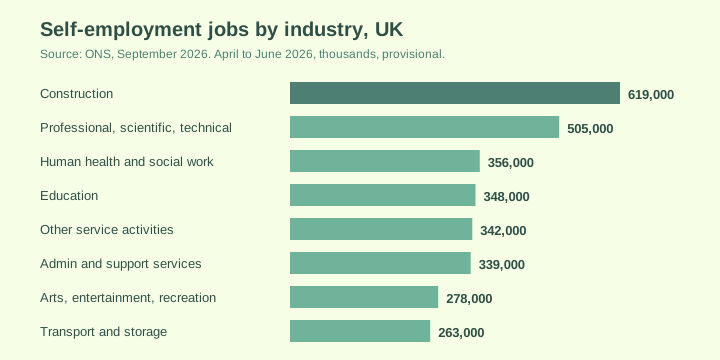
Here's what sits in each one:
- Construction (619,000). Builders, electricians, plumbers, plasterers, roofers and decorators.
- Professional, scientific and technical (505,000). Accountants, consultants, designers, architects, photographers and similar freelancers.
- Human health and social work (356,000). Self-employed therapists, carers and similar roles.
- Education (348,000). Tutors, driving instructors, sports and music coaches.
- Other service activities (342,000). Hairdressers, beauticians and repair work sit in this group.
- Administrative and support services (339,000). Cleaners, gardeners and office support.
- Arts, entertainment and recreation (278,000). Musicians, entertainers and fitness instructors.
- Transport and storage (263,000). Couriers, taxi drivers and delivery drivers.
The job examples are my own plain-English reading of what each section covers. The ONS spreadsheet gives the section totals, not individual trades.
Construction is shrinking, but still top
Construction is first, but it has lost ground. In April to June 2021 the same table shows about 735,000 self-employment jobs in construction. By April to June 2026 that's 619,000. A drop of 116,000, or around 16%.
A year ago, in April to June 2025, it was about 647,000. So the fall hasn't stopped.
The ONS file doesn't say why, so I won't guess. What I can say is that it's still about 114,000 jobs ahead of the next industry.
Who's growing
Compare the same quarter in 2021 and 2026 and a few industries have gone up:
- Education: from about 284,000 to 348,000, up 64,000.
- Professional, scientific and technical: from about 498,000 to 505,000, a small rise.
- Transport and storage: from about 242,000 to 263,000.
- Human health and social work: from about 332,000 to 356,000.
And a few have gone down:
- Wholesale and retail trade: from about 309,000 to 237,000.
- Accommodation and food service: from about 151,000 to 121,000.
Overall, the total is almost flat. It was about 4.21 million in April to June 2021 and about 4.18 million in April to June 2026. The mix is changing more than the headline number.
If you want the bigger picture on how the total has moved, I wrote about it in how many self-employed people there are in the UK.
What this means if you work for yourself
Most of these jobs share one thing. You do the work first, and then you get paid. A plumber fits the boiler and sends the invoice. A tutor teaches the term and waits for the transfer. A cleaner cleans for four weeks and bills on the last day.
That gap between finishing the work and getting the money is where small businesses get squeezed. If you want to see what these jobs earn on average, I covered that in average self-employed income in the UK.
My take
The thing I notice is how ordinary the top of this list is. It's not tech founders. It's people who fix, teach, clean, drive and look after other people. They're running a business of one, usually with a phone and a van or a laptop.
That's who I'm building Vcents for. You ask for the money in a WhatsApp message, and your customer pays from their bank app. No invoice software to learn, and no chasing in a separate tool. You can see more at v-cents.com.
Sources
- ONS, JOBS04: Self-employment jobs by industry, published 15 September 2026 (UK totals table, April to June 2021, 2025 and 2026; figures added up by section by Vcents)
Vcents turns the thread into a payment.
Ask for money in plain English. Your customer taps once, authorises in their own bank, and the receipt lands back in the chat.
How receiving payments works