Average self-employed income in the UK: the real numbers
What is the average self-employed income in the UK? HMRC data shows £118bn of profit across 5.62m sources, about £21,000 each, and a big gap in the middle.
HMRC counted 5.62 million self-employment income sources in the 2023 to 2024 tax year. Together they made £118 billion in profit.
Do the sum and you get about £21,000 per source. That's my own rough calculation, not an HMRC figure, and it comes with caveats. But it's a good place to start when someone asks about the average self-employed income in the UK.
What is the average self-employed income in the UK?
HMRC's Personal Incomes Statistics, published on 29 April 2026, cover the tax year ending 5 April 2024. They say there were 5.62 million self-employment sources, accounting for £118 billion of profit.
The tax year before, HMRC reported 5.63 million sources and the same £118 billion (published 12 March 2025). So the picture is flat. Not much growth, not much decline.
Divide £118 billion by 5.62 million and you get roughly £21,000. Both HMRC numbers are rounded, so treat my result as "around £21,000", not an exact figure.
Two things to know about that number.
First, it counts sources, not people. One person can have more than one self-employment source. HMRC says 5.34 million individuals had at least one source in 2023 to 2024, down 0.6% from 5.37 million.
Second, it's a mean. A few high earners pull a mean up. HMRC's published commentary doesn't give a median for self-employment profit, so I can't tell you what the typical person in the middle makes. If you want that figure, the detailed tables are on the GOV.UK statistics page.
How many self-employed people pay income tax?
Of the 5.34 million individuals, HMRC classes 3.67 million as taxpayers. The year before it was 3.53 million out of 5.37 million.
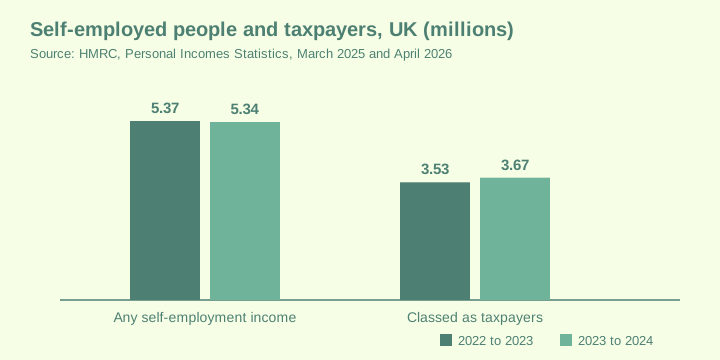
Subtract and you get about 1.67 million people with self-employment income who weren't classed as taxpayers in 2023 to 2024. That's roughly one in three. Again, that's my arithmetic on HMRC's figures.
It doesn't mean they earn nothing. Some do self-employed work on top of a job. Some are below the tax threshold. Some had a slow year. The data doesn't say which.
What it does show is that "self-employed" covers very different lives. Side income and full-time trade sit in the same count.
Which self-employed jobs earn the most?
Construction is the biggest industry. HMRC says it holds 22.7% of all sources and 21.6% of all profits. That's a slightly smaller share of profit than of people.
HMRC also says legal and accounting, and finance, insurance and real estate, make up a notably higher share of profit than of sources. That means higher-than-average profits per person in those fields.
Year on year, information and communication saw the largest rise in self-employment income, up 8.8%. Finance, insurance and real estate saw the largest fall, down 18.4%.
So the average hides a wide spread by trade. A freelance accountant and a self-employed cleaner are in the same dataset. They aren't in the same position.
What does this mean if you run a one-person business?
Say you're a tutor who made £21,000 profit last year. That's about £1,750 a month before tax. (Example only, using the rough average above.)
Now say two of your customers pay three weeks late in the same month. If each owes you £300, that's £600 missing from a month where you expected £1,750. That's more than a third of your month.
I'm not saying the average person has this problem. I'm saying that on an income this size, a few late payments matter a lot. There's not much room to absorb them.
The same goes for any big, single hit. A tax bill, a quiet January, a van repair. When profit is around £21,000, there isn't a lot of slack.
How to use the average
Don't use it as a target. Use it as a rough check.
- If you make more than the mean, remember a few big earners pull it up. You may still be above the typical person.
- If you make less, check your trade first. Averages across all industries are a poor guide for a single trade.
- Check what you actually keep. Profit isn't what's left after tax, and HMRC's number is profit.
The honest answer to "what's the average self-employed income in the UK" is: about £21,000 a source, with a wide spread and a lot of people at the low end. If you want to know where you stand, compare your own profit across your own months, not against a national number.
Getting paid on time is the part of self-employment you control least, and it hurts most on incomes like these. Vcents lets you request and send payments from WhatsApp, with the customer paying straight from their bank app. If you want the background, read the real cost of chasing and how many self-employed people there are in the UK.
Sources
Vcents turns the thread into a payment.
Ask for money in plain English. Your customer taps once, authorises in their own bank, and the receipt lands back in the chat.
How receiving payments works