The Late Payments Bill: what it means if you're self-employed
The UK's Late Payments Bill caps payment terms at 60 days and gives the Small Business Commissioner new powers. Here's who it helps, who it doesn't, and what you can use today.
In May the government put the Small Business Protections Bill before Parliament. It calls it the largest crackdown on late payment in over 25 years. If you work for yourself, you probably saw the headline and wondered if it changes anything for you.
The short answer: it depends on who pays you. If your clients are businesses, it helps. If your clients are people, it doesn't touch you at all.
Here's the detail.
How big the problem is
The government asked London Economics to put a number on late payment. Their report came out in July 2025.
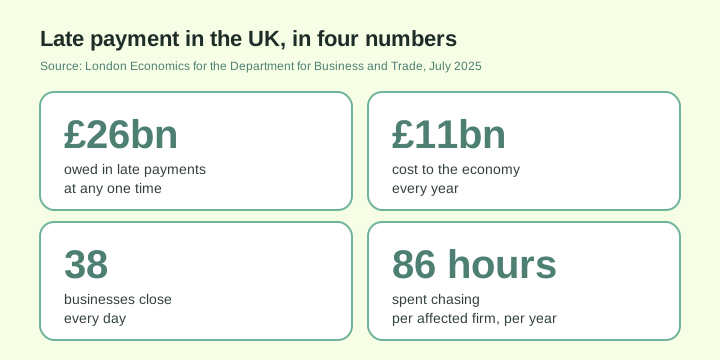
A few figures stand out:
- Over 1.5 million businesses are affected. That's 28% of all UK businesses.
- £26 billion is owed in late payments at any one time. That's about £17,000 for each affected business.
- Around 14,000 extra businesses close every year because of it. That's 38 a day.
- Affected businesses spend 86 hours a year chasing money.
That last one is the number I keep coming back to. 86 hours is more than two full working weeks. For a sole trader there's no finance team to pass it to. It's your evenings.
Micro businesses get hit hardest. The report found they have 4.61% of their annual turnover tied up in late payments. That's a lot of money to be waiting on when you're one person.
What the bill actually does
These are the main changes, based on the government's announcement and the law firm guides that followed it:
- A 60-day cap on payment terms. When a larger business buys from a smaller supplier, it can't set terms longer than 60 days. Shorter terms you've agreed still apply.
- Interest you can't sign away. Statutory interest on late B2B payments is 8% above the Bank of England base rate. Today big clients often write a lower rate into the contract. The bill stops that.
- 30 days to dispute an invoice. A customer gets a fixed window to say an invoice is wrong. If they raise it later, interest still runs.
- More power for the Small Business Commissioner. The Commissioner can investigate, settle disputes and fine persistent late payers. The government says fines could be worth tens of millions.
- Public reporting. Large companies will have to report how much they paid late and how much interest they owe.
None of this is law yet. Farrer & Co's guide says the changes are expected no earlier than 2027.
Who it helps
If you invoice businesses, this is good news. Think freelance designers, developers, copywriters, consultants, trades working for contractors. The 60-day cap matters most when you supply a company much bigger than you. That's the deal where you have the least power to push back on 90-day terms.
Who it doesn't help
If your customers are people, not companies, the bill does nothing for you. Tutors paid by parents. Cleaners paid by households. Hairdressers, personal trainers, dog walkers.
UK late payment law has always been business-to-business. The 1998 Act that gives you statutory interest doesn't cover consumers. The new bill builds on that same base. So a parent who's three weeks late on tutoring fees isn't affected by any of it.
For a lot of self-employed people, that's most of their income. Their late payments aren't a big company squeezing them. They're a friendly customer who meant to pay and forgot.
What you can use today
You don't have to wait for 2027.
If you invoice businesses, you already have rights under the current law:
- If you didn't agree a payment date, payment is due 30 days after the customer gets your invoice or the work.
- You can charge interest at 8% above base rate on late payments.
- You can add a fixed sum for recovery costs: £40 on debts under £1,000, £70 from £1,000 to £9,999.99, and £100 on £10,000 or more.
Most sole traders never use these. Even putting a line about them on your invoice can change how fast you get paid.
If you're paid by people, the law won't do the work for you. What works is making payment easy and asking at the right time:
- Agree the price and how you'll be paid before you start.
- Send the request the same day you finish, while the job is fresh.
- Ask in the place you already talk to them. If you book over WhatsApp, ask over WhatsApp.
- Make paying one tap, not "here are my bank details, please use your surname as the reference".
- Keep track of who has paid, so a reminder is a quick note and not an awkward guess.
My take
The bill is a real step. The 60-day cap and the stronger Commissioner will help a lot of small suppliers who've been stuck waiting on big clients.
But most self-employed people in the UK don't get paid late by big companies. They get paid late by people they like, because paying took too many steps. No law fixes that. Better tools do.
That's the problem we're working on at Vcents. You ask for the money in WhatsApp, your customer pays from their own bank in a tap, and you can see who has paid.
Sources
- GOV.UK, Largest crackdown on late payments in over 25 years as landmark Bill enters Parliament, 19 May 2026
- London Economics for the Department for Business and Trade, Late payments research: estimating the total economic impact, July 2025
- Farrer & Co, The government's late payment reforms: a practical guide for businesses, May 2026
- GOV.UK, Late commercial payments: charging interest and debt recovery
Vcents turns the thread into a payment.
Ask for money in plain English. Your customer taps once, authorises in their own bank, and the receipt lands back in the chat.
How receiving payments works