How many people miss the Self Assessment deadline?
How many people miss the Self Assessment deadline? HMRC says about 1 million missed 31 January 2026. Here is what that costs and how to avoid it.
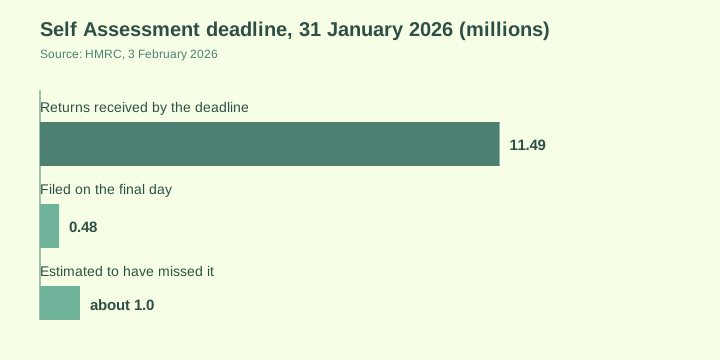
On 31 January 2026, 475,722 people filed their tax return on the final day. HMRC counted another 27,456 in the last hour alone.
And about a million people still missed it.
That's the answer to "how many people miss the Self Assessment deadline". It's roughly one in twelve of the people HMRC expected to file. Here are the numbers, what a miss costs, and the dates for this year.
How many people miss the Self Assessment deadline?
HMRC published the figures for the 2024 to 2025 tax year on 3 February 2026. It had expected 12,029,168 returns. By the deadline it had received 11,489,825.
HMRC says that after adjustments, 10,957,825 of the expected returns arrived on time. That's 91.09%. It estimates that "an estimated 1 million customers missed the deadline".
Note the word "estimated". HMRC doesn't know exactly how many people were due to file and didn't. Some will have had nothing to file after all. Treat "about a million" as the headline, not an exact count.
Almost everyone files online. HMRC says 11,173,825 returns (97.25%) were online and 316,000 (2.75%) were on paper.
What does missing the deadline cost?
GOV.UK sets out the late filing penalties. They apply to the return, not to the tax, so you pay them even if you owe nothing.
- An initial £100 penalty.
- After 3 months, £10 a day, up to a maximum of £900.
- After 6 months, 5% of the tax due or £300, whichever is greater.
- After 12 months, another 5% or £300, whichever is greater.
Add those up and a return that is a year late can cost at least £1,600 in filing penalties. That's my sum from the GOV.UK list, and it assumes the £300 minimum applies each time.
Paying late is a separate penalty. GOV.UK says it's 5% of the unpaid tax at 30 days, 6 months and 12 months, plus interest.
Say you're a dog walker who earned £14,000 in profit. You file in March instead of January. You'd get the £100 penalty straight away, for a form you could have sent in an evening.
You can appeal if you had a reasonable excuse. Don't plan on it.
Why do people miss it?
I can't tell you from HMRC's numbers. They don't give reasons. But here are the reasons I'd guess, as a founder who builds for self-employed people.
- The bill is big, so the form gets put off.
- Records are in a shoebox, a banking app and three WhatsApp threads.
- Customers haven't paid yet, so the money to cover the tax isn't there.
That last one is the most common, and it's not a filing problem. It's a getting-paid problem. If you're waiting on invoices in January, your tax bill is the thing that suffers. I wrote about how to chase an unpaid invoice for that reason.
What are the dates for 2025 to 2026?
From GOV.UK's deadlines page:
- Tell HMRC by 5 October 2026 if you need to file a return and haven't before.
- Paper return: HMRC must receive it by 11:59pm on 31 October 2026.
- Online return: submit by 11:59pm on 31 January 2027.
- Want to pay through your tax code? Submit by 11:59pm on 30 December 2026.
- Pay your tax by 11:59pm on 31 January 2027.
- Second payment on account: 31 July 2027.
Filing and paying share the same January date. So you can't put off the money and the form separately.
How to not be one of the million
- File early. You can submit from 6 April, once the tax year ends. Nothing stops you doing it in April.
- Set tax money aside as each payment lands, not in January.
- Keep one place for income and expenses. Reporting is moving that way anyway, as I explain in Making Tax Digital for sole traders.
If you're not sure how many other people work for themselves, I counted that too: how many self-employed people there are in the UK.
My take
A million people facing a £100 penalty isn't a story about lazy people. It's a story about a deadline that lands on the quietest month of the year for cash, with a form that is easy to leave until later.
At Vcents we're building something small for the part before that. Customers pay by bank transfer from a link in WhatsApp, and you can see who has paid. It won't file your return. But it makes January a little less empty.
Sources
Vcents turns the thread into a payment.
Ask for money in plain English. Your customer taps once, authorises in their own bank, and the receipt lands back in the chat.
How receiving payments works