Card payment fees for small business UK: what you pay
Card payment fees for small business UK: a £250 job costs between £2.50 and £7.20 to collect, depending on the rail. Here are the published numbers.

A customer pays you £250 for a job. You don't get £250.
How much you lose depends on how they pay. I looked up the published prices for card payment fees for small business UK and worked out what that one £250 payment costs on each. The gap is bigger than most people expect.
What are the card payment fees for small business UK?
There's no single rate. Each provider sets its own, and the rate changes with the type of card.
Stripe's UK pricing page (checked 1 November 2026) lists these rates for online payments:
- Standard UK cards: 1.5% + 20p
- Premium UK cards: 2.8% + 20p
- International cards from the EEA: 2.5% + 20p
- International cards from outside the EEA: 3.15% + 20p
- Bacs Direct Debit: 1%, with a 20p minimum and a £4.00 cap
SumUp's UK pricing page (same date) lists 1.69% for in-person card payments on its pay-as-you-go plan, including American Express and premium cards. That plan has no monthly fee.
Other providers have their own rates. These two are public and easy to check, so I used them.
What does one £250 payment cost?
Say you're a cleaner or a tutor, and a customer pays £250. Here's the fee on each option. The sums are mine, using the published rates.
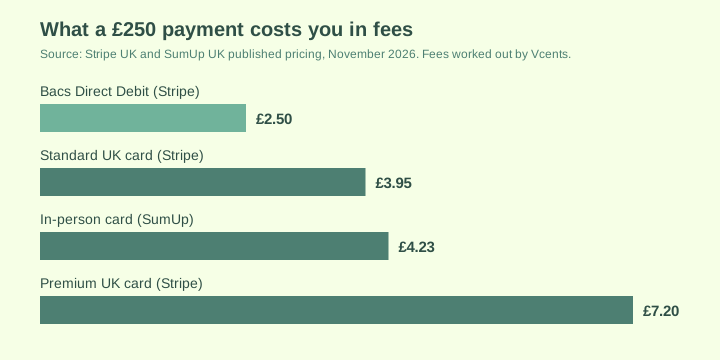
- Bacs Direct Debit: £2.50
- Standard UK card at Stripe: £3.95
- In-person card at SumUp: £4.23
- Premium UK card at Stripe: £7.20
The same £250 costs nearly three times as much on a premium card as on Direct Debit. And you don't pick the card. The customer does.
Why does the fee depend on the card?
Part of every card fee goes to the card networks, Visa and Mastercard. The Payment Systems Regulator (PSR) published its final report on those network fees on 6 March 2025. It found that Mastercard and Visa had "increased their core scheme and processing fees to acquirers by at least 25% since 2017", costing businesses "at least £170million extra per year".
The PSR also said that unclear fee information has led to costs for merchants, "including small retailers". Its page says the higher fees "could lead to direct economic constraints, particularly for small merchants."
So the regulator agrees the cost is real. The British Retail Consortium wrote in April 2026 that the PSR's proposals still focus on transparency and pricing governance. It says that on its own that won't limit fee increases, and it wants price caps. That's the BRC's position, not the regulator's. The BRC also said that remedy consultations were expected through 2026. Don't expect your fees to drop soon.
What does it add up to over a year?
Fees look small on one payment. They don't look small on a year.
Say you take £30,000 a year in card payments in person at 1.69%. That's £507 in fees. That's my sum, not a figure from SumUp. It ignores any monthly plan fee, VAT and the mix of cards your customers use.
On a standard UK card at Stripe's rate, the same £30,000 split into 120 payments of £250 would cost 120 x £3.95 = £474. The 20p part matters more when payments are small. On a £10 payment, 20p is 2% on its own.
If your average job is small, a flat part of the fee hurts. If your average job is large, the percentage hurts.
What can you do about it?
You can't change the card your customer picks. But you can change a few things.
- Check your rate. Find your provider's rate card and see which tier your customers fall into. Many people have never looked.
- Watch for the extras. Monthly fees, minimum charges and terminal rental all sit on top of the percentage. SumUp's own page lists plans from £19 a month. Whether a plan pays off depends on how much you take.
- Offer a bank payment for bigger jobs. A bank transfer doesn't go through Visa or Mastercard. I explain how in what is Open Banking.
- Don't fall back on cash. It avoids the fee, but it has its own costs. I covered those in should I accept cash.
- Count fees as an expense. Card fees are a business cost. See what expenses you can claim.
My take
A fee of 1.5% sounds small. On a £250 job it's under £4. But few people add it up across a year. On £30,000 of takings it's roughly £470 to £510, going to fees.
I don't think cards are bad. Customers like them and they're fast. But you should know the number, and you should know there's another route for bigger payments.
At Vcents, you ask a customer for money in WhatsApp and they pay from their own bank app, straight into your account. No card in the middle. I'd still check any provider's rates yourself, ours included.
Sources
- Stripe UK pricing, checked 1 November 2026
- SumUp UK pricing, checked 1 November 2026
- Payment Systems Regulator, market review of card scheme and processing fees: final report, 6 March 2025
- British Retail Consortium, PSR card fees reviews: latest update and next steps, 21 April 2026
Vcents turns the thread into a payment.
Ask for money in plain English. Your customer taps once, authorises in their own bank, and the receipt lands back in the chat.
How receiving payments works