VAT threshold for sole traders UK: what the data shows
The VAT threshold for sole traders in the UK is £90,000. See what HMRC data shows about how many traders sit below it, just above it and far over it.

The VAT threshold for sole traders in the UK is £90,000. Cross it and you have to register for VAT. HMRC's latest figures show a surprising number of businesses already sit on the other side of that line, and a lot of them sit just above it.
I wanted to see where sole traders and small firms actually fall. So I read HMRC's annual VAT statistics, updated on 3 December 2025, which cover the 2024 to 2025 financial year.
What is the VAT threshold for sole traders in the UK?
GOV.UK says you must register for VAT if your total taxable turnover for the last 12 months goes over £90,000. It also says you must register if you expect your taxable turnover to go over £90,000 in the next 30 days.
Two details catch people out.
- The test is rolling. It's not the tax year. You check the last 12 months, every month.
- Turnover means taxable sales, not profit. Your costs don't reduce it.
Say you're a tutor who bills £7,600 a month. Over 12 months that's £91,200. You're over the threshold, even if your profit is much lower after costs. GOV.UK says that after you cross, you have 30 days after the end of that month to register. Your VAT start date is the first day of the second month after you crossed.
How many traders are VAT registered?
HMRC counted 2,330,400 VAT traders in 2024 to 2025. That's up 11,400 on the year before. In the same year, 234,000 traders registered and 218,000 de-registered.
Here's how they split by turnover.
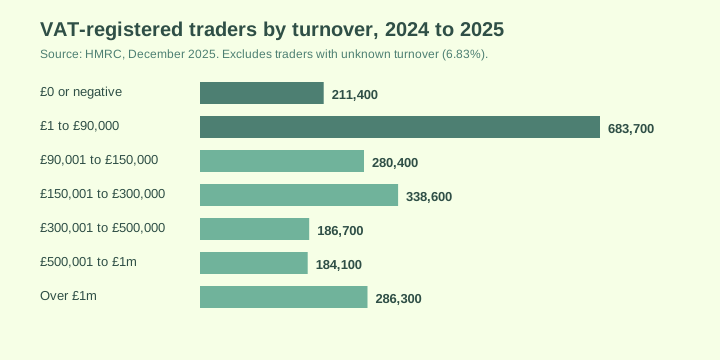
The chart groups HMRC's four bands above £1m into one bar. HMRC says traders with unknown turnover are 6.83% of the population, and they aren't in the bands.
Why are so many VAT traders under the threshold?
HMRC says 38% of traders declared an annual turnover up to and including the £90,000 threshold. That's 895,100 traders across the first two bands. They're VAT registered even though their turnover is at or below the point where registration is compulsory.
HMRC's page doesn't say why. I can only guess, and it's a guess: some register voluntarily, some are new and haven't built up sales yet, and some had a quiet year after growing past the threshold earlier. Treat that as my reading, not HMRC's finding.
The next band up is the one I'd watch if you're a sole trader. HMRC counted 280,400 traders with turnover above the threshold and up to £150,000. That's the group that has just crossed the line.
What does that mean for a sole trader near the line?
Think of the 280,400 traders in the £90,001 to £150,000 band. For most of them, crossing the threshold was probably not a single dramatic day. It was a slow climb, one busy month after another.
Here's an example. Say you're a cleaner who bills £7,000 a month for most of the year, then takes on two commercial contracts and bills £9,000 a month. Your rolling 12 months creeps up each month. No single invoice feels like the one that tips you over. That's why checking the running total matters more than checking one big job.
It also helps to know which of your sales count. GOV.UK's rule is about taxable turnover, so ask an accountant if you aren't sure which of your income is included.
Who pays most of the VAT?
Not small businesses. HMRC says traders with turnover over £10 million paid 75% of total net Home VAT liability, which was £133 billion. There were 45,800 of them.
The 280,400 traders between £90,000 and £150,000 paid £2.0 billion in net Home VAT liability, about 1.1% of the total. A big group of registrants carries a small share of the bill.
I don't read that as a sign VAT is unimportant for you. For a one-person business, it changes your prices and your paperwork a lot, even if the Treasury's totals barely move.
What changes for you after you register?
I'm sticking to the two things the sources I read confirm.
- You have to register within the deadline. GOV.UK gives 30 days after the end of the month you went over.
- Your effective date is set by the rule above, so check the date before you quote customers.
Beyond that, check the VAT schemes and the rules on how to charge on GOV.UK or with an accountant. I haven't covered them here because I haven't confirmed the details today.
If you're also working out your tax side, our guides on making tax digital for sole traders and how to save for tax cover the other deadlines that bite as you grow.
My take
Hitting £90,000 feels like a milestone. It's also an admin event with a clock on it. The sensible move is to check your rolling 12 months every month once you pass about £70,000 of sales. Waiting for the end of the tax year is the mistake.
At Vcents, we keep a record of each payment request you send over WhatsApp, with its amount. That makes your rolling turnover easier to add up when you need it.
Sources
Vcents turns the thread into a payment.
Ask for money in plain English. Your customer taps once, authorises in their own bank, and the receipt lands back in the chat.
How receiving payments works