Self-employed pension UK: how many actually save?
Self-employed pension UK: only 22% of people earning over £10,000 were saving into one in 2022, down from 60%. Here are the numbers and your options.
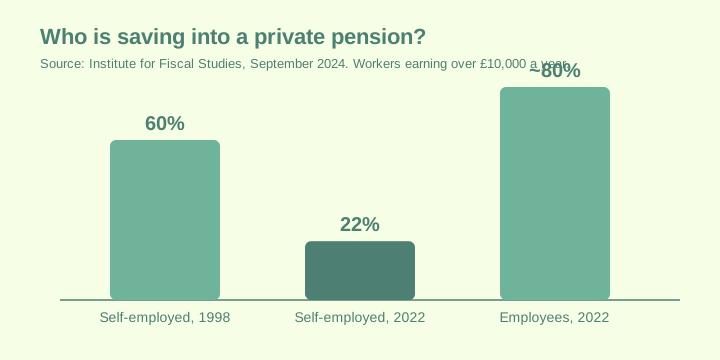
In 1998, three in five self-employed people earning over £10,000 were saving into a pension. By 2022 it was 22%.
That's the headline from the Institute for Fiscal Studies (IFS), and it's the best answer I've found to the question behind "self employed pension UK": do other people like me actually do this? Mostly, no. Here's what the numbers say, and what you can do about it without a big monthly commitment.
How many self-employed people have a pension?
The IFS published a report on private pensions for the self-employed in September 2024. It looked at workers earning over £10,000 a year, the group who would be automatically enrolled if they were employees.
Its findings:
- In 2022, 22% of those self-employed workers were saving into a private pension.
- In 1998 the figure was 60%.
- It has barely moved since around 2012.
- Among employees earning over £10,000, around 80% were saving in 2022.
The IFS also says only a third of the fall between the mid 2000s and mid 2010s can be explained by who is self-employed now, such as lower incomes. The other two thirds is unexplained.
A second source gives a similar picture. In a letter dated 6 November 2024, the Northern Ireland Minister for Communities said the latest Great Britain pension participation rate for the self-employed was 18%. The measures differ, so don't compare 18% and 22% directly. Both say roughly one in five.
Why is it so low?
Employees get automatic enrolment. Their employer sets up the pension and takes the contribution from their pay. The self-employed don't get that. The Northern Ireland letter notes automatic enrolment hasn't applied to them since it began in 2012.
The same letter gives a reason that rings true. Self-employed incomes go up and down, so a fixed monthly amount often isn't realistic. You also need cash on hand for your business and for surprise bills.
I'd add one more, as someone who builds for this group. When a customer pays you late, the pension is the first thing to go. Tax comes first, then rent. The pension comes last. If you're waiting on invoices, I wrote about how to chase an unpaid invoice.
What does the state pension give you?
GOV.UK says the full rate of the new State Pension is £241.30 a week. That's about £12,548 a year, by my sum (£241.30 times 52). You need 35 qualifying years on your National Insurance record to get the full amount if your record started after April 2016.
Say you're a cleaner who earns £30,000 in profit. The full state pension would be about 42% of that (£12,548 of £30,000, by my sum). The IFS ran projections on this. If self-employed people keep saving at today's rates, it estimates around 55% would have no pension savings on top of the state pension. It says two thirds wouldn't reach a standard "replacement rate" target, and three quarters wouldn't reach the Pensions and Lifetime Savings Association minimum income standard. That assumes people save at the same rate for their whole career, so treat it as a warning, not a forecast.
The IFS also points out that many self-employed people have other wealth, such as property, or a partner with a pension. A pension isn't the only way to save for retirement, but it does come with tax relief.
What are your options?
You have to set one up yourself. The Northern Ireland letter lists the main routes:
- NEST. A government-backed scheme that self-employed people can join. The letter says you can pay in as often as you like, as long as it's at least £10 each time.
- A personal pension. You choose how much to pay in and how it's invested.
- A SIPP. Like a personal pension, but you pick the investments.
- A stakeholder pension. Offered by banks, building societies and insurers, with flexible contributions and low charges.
The letter was written in 2024, so check the current NEST rules on their own site before you sign up.
How does tax relief work?
GOV.UK says the pension provider claims tax relief at the basic 20% rate and adds it to your pot. So if you pay in £80, your pot gets £100. That's my arithmetic from the 20% rate.
If you pay higher-rate tax, you can claim more through your Self Assessment return. GOV.UK says that's 20% up to the amount of any income you paid 40% tax on, and 25% up to the amount you paid 45% tax on. Scottish taxpayers have different bands. Relief is available on contributions worth up to 100% of your annual earnings.
A practical way to start
The IFS found that many self-employed savers pay the same cash amount for years instead of raising it as earnings grow. Don't do that. Pick a small number and set a date to raise it.
Here's one way to make it painless:
- Open a pension with a minimum you can afford, even £10.
- Pay in when a big invoice lands, not on a fixed day.
- Put it in the same place you save for tax.
- Each April, raise it a bit.
Paying when you get paid fits how self-employed money works. The catch is you need to know when the money has actually arrived.
My take
I don't think 22% means self-employed people don't care. I think the system was built for employees, and the rest of us were left to sort it out ourselves. Small, flexible and linked to getting paid is the only version I can see working.
That's the part Vcents is built around. Customers pay straight into your bank account, and you see it right away in WhatsApp. That's the moment to move some into your pension.
Sources
- Institute for Fiscal Studies, Private pensions for the self-employed: challenges and options for reform (IFS Report R330), September 2024
- Northern Ireland Department for Communities, letter on workplace pensions, 6 November 2024
- GOV.UK, New State Pension: what you'll get
- GOV.UK, Tax on your private pension: pension tax relief
Vcents turns the thread into a payment.
Ask for money in plain English. Your customer taps once, authorises in their own bank, and the receipt lands back in the chat.
How receiving payments works