How much tax on £30,000 self-employed in the UK?
How much tax do you pay on £30,000 self-employed in the UK? About £4,532 in 2026 to 2027. See the sums, and what you'd owe at £20,000, £40,000 and £50,000.
How much tax on £30,000 self-employed? If that's your profit for the 2026 to 2027 tax year, you'd owe about £4,532 in total. That's £3,486 in income tax and £1,046 in Class 4 National Insurance. You'd keep roughly £25,468.
That's about 15% of your profit. Most people guess higher. Let's go through where the number comes from.
First, "£30,000" means profit
Tax is charged on your profit, not on what customers paid you. Profit is your income minus the costs of running the business. If a cleaner takes £38,000 from customers and spends £8,000 on supplies, fuel and insurance, the profit is £30,000.
I'll use profit in every figure below. If you're not sure what counts, my post on the trading allowance covers the £1,000 shortcut some people can use instead of listing costs.
The sums for £30,000
According to GOV.UK's income tax rates page, checked in October 2026, the tax year runs from 6 April 2026 to 5 April 2027. The Personal Allowance is £12,570. You pay 20% on taxable income from £12,571 up to £50,270.
Here's the income tax:
- Profit: £30,000
- Take off the Personal Allowance of £12,570. That leaves £17,430.
- 20% of £17,430 is £3,486.
Self-employed people also pay Class 4 National Insurance. GOV.UK's self-employed National Insurance page says that for 2026 to 2027 you pay 6% on profits over £12,570, up to £50,270. Above that it's 2%.
- Profit over £12,570: £17,430
- 6% of £17,430 is £1,045.80
Add them up: £3,486 plus £1,045.80 is £4,531.80. That leaves £25,468.20 of the £30,000.
The effective rate is the total divided by your profit. At £30,000 that's £4,531.80 divided by £30,000, which is 15.1%. The first £12,570 is untaxed, so the average rate sits well below the 26% you pay on each extra pound.
What about Class 2?
You may remember paying Class 2 National Insurance every week. GOV.UK says that if your profits are £7,105 or more a year, you don't have to pay Class 2. It's treated as paid, so your National Insurance record is still protected. At £30,000 you pay nothing extra.
Below £7,105 you can choose to pay voluntary Class 2. GOV.UK gives the rate as £3.65 a week.
The same sums at other profit levels
I ran the same method at four profit levels. The method is the same each time: 20% income tax and 6% Class 4 on everything over £12,570.
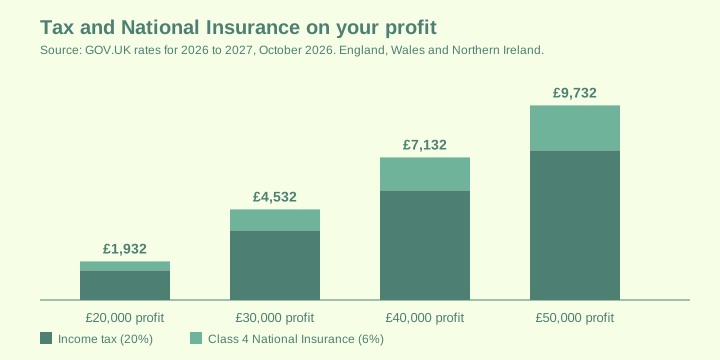
| Profit | Income tax | Class 4 NI | Total | You keep | |---|---|---|---|---| | £20,000 | £1,486.00 | £445.80 | £1,931.80 | £18,068.20 | | £30,000 | £3,486.00 | £1,045.80 | £4,531.80 | £25,468.20 | | £40,000 | £5,486.00 | £1,645.80 | £7,131.80 | £32,868.20 | | £50,000 | £7,486.00 | £2,245.80 | £9,731.80 | £40,268.20 |
Every extra £10,000 of profit adds £2,600 of tax and National Insurance. That's 26p in each extra pound, until you reach £50,270. Above that, GOV.UK says income tax rises to 40% and National Insurance drops to 2%.
What these figures leave out
I kept this simple on purpose. A few things change your real bill:
- Scotland. Scotland sets its own income tax rates. I used the rates for England, Wales and Northern Ireland, so check the Scottish rates if you live there.
- Other income. A part-time job or rental income uses up your allowance first.
- Student loans. Repayments are collected through your tax return and aren't in these figures.
- Payments on account. HMRC can ask you to pay in advance towards next year's bill. I explain it in payments on account, explained.
- Business costs. Every allowable cost you claim lowers your profit, and so lowers the tax.
The point is the cash, not the percentage
Say you're a tutor with £30,000 profit. Your tax bill lands in January as one lump of about £4,500. If you've spent that money, it's a bad month. If you've set it aside, it's just a payment.
A simple rule is to move 15% to 20% of each payment you receive into a separate account the day it arrives. For £30,000 profit, the true figure is about 15%. Rounding up gives you a cushion for the extras above. My post on how to save for tax when you're self-employed shows how to set that up.
I built Vcents because getting paid on time is what makes this easy. You can't set money aside that hasn't arrived. Vcents lets you ask customers to pay by bank transfer from a WhatsApp chat, so the money lands in your own account sooner.
Sources
- GOV.UK, Income Tax rates and Personal Allowances, tax year 6 April 2026 to 5 April 2027, checked October 2026
- GOV.UK, Self-employed National Insurance rates, tax year 2026 to 2027, checked October 2026
- GOV.UK, Scottish Income Tax, checked October 2026
Vcents turns the thread into a payment.
Ask for money in plain English. Your customer taps once, authorises in their own bank, and the receipt lands back in the chat.
How receiving payments works